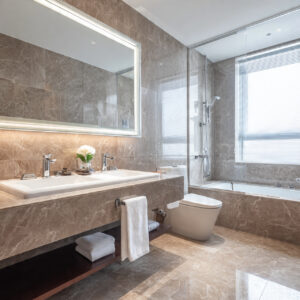
Natural marble stands as an immutable pillar of high end interior design, serving as the definitive hallmark of refined luxury. However, when it comes to creating your private sanctuary, the decision is rarely simple. To help you make the best investment for your home, this guide will deeply compare marble and quartz bathroom options, balancing the flawless beauty bestowed by Mother Nature with the absolute resilience of modern technology.
Our bathroom deserves to be seen as a private sanctuary, a space separate from the outside world, the only place where we can truly regenerate energy and find balance. The comparison between marble and quartz for the bathroom is an uncompromising battle between the flawless beauty bestowed by Mother Nature and the almost absolute resilience of modern technology. This choice not only affects the cost but also determines the amount of time you need to dedicate to caring for your space in the years to come.
The truth is, the secret doesn’t lie in owning a magnificent villa. With the experience of someone who shares a passion for materials, I will help you analyze every aspect. Let’s find out which material truly deserves a place in your heavenly bathroom, after carefully considering the practicalities when comparing marble and quartz for the bathroom.
1. The Essence of Timeless Luxury Marble

If the bathroom is a work of art, marble is the material that creates that masterpiece. The cool feeling to the touch, the unique veining, is why marble is consistently the “dream” material for every designer.
1.1. Unmatched Advantages: Irreplicable Aesthetic Value

What makes Marble so special?
-
Unique Individuality: This advantage is undeniable. Each slab is unique, carrying millions of years of geological history within it. Your bathroom will truly be a custom designed masterpiece.
-
Visual Depth: Marble has the ability to gently reflect light (when polished) and create a depth that artificial materials often struggle to achieve. Stones like Calacatta or Statuario convey a sense of timeless sophistication and class.
-
Real Estate Value: This is a smart investment. According to the assessment of experts and home buyers, the presence of natural marble in the bathroom immediately increases the home’s value.
1.2. Necessary Limitations: The Challenge of Porosity and Durability

However, this luxury demands a trade off:
-
Porous Nature: Marble is a natural stone with a porous structure. This makes it susceptible to staining from water, oil, and colored liquids (like hair dye) if not thoroughly sealed.
-
Vulnerability to Acid Etching: This is marbles biggest “enemy.” Lemon juice, vinegar, or even some harsh cleaners can cause a chemical reaction on the surface, creating dull spots (etching) that reduce the stone’s shine.
-
Lower Durability: Compared to quartz, marble is softer, making it more prone to scratching and chipping, especially at the edges. It requires much more meticulous and careful maintenance.
2. Engineered Quartz: Modern, Durable and Practical

Quartz is not a solid natural stone but a material created by combining about 90-95% natural quartz crystals (crushed) with polymer resins and pigments. This is the “warrior” of modern design.
2.1. Technical Resilience: Absolute Stain Resistance
The advantages of quartz typically focus on practicality and durability:
-
Non Porous and Fully Hygienic: Thanks to the polymer resin, quartz is non porous, meaning it is 100% stain resistant. Quartz is ideal for bathrooms because it harbors no bacteria and is easy to clean with common detergents (though overly harsh cleaners should still be avoided).
-
Superior Durability: Quartz is much harder than marble. It is nearly scratch-proof, withstands impacts better, and is less prone to chipping, making it ideal for families with children or high-traffic bathrooms.
-
No Sealing Required: Saving time and the cost of periodic maintenance is a huge advantage.
2.2. Design Constraint Veining Repetition Issue

Although technology has advanced significantly, Quartz still has certain limitations:
-
Pattern Repetition: While manufacturers have created impressive marble look patterns, when used on large slabs, you can still notice the pattern repetition, which detracts from the natural “artistic” feel.
-
Lack of Depth: Being compressed and synthesized, quartz has a more uniform surface. It lacks the optical depth and subtle light variations that natural marble provides.
-
Heat Sensitivity: Although hard, quartz is more sensitive to high temperatures than marble. Placing hot styling tools (like curling irons, straighteners) directly on the countertop can melt or discolor the polymer resin.
3. In Depth Analysis Direct Comparison in a Bathroom Environment
When making the final decision, the choice hinges on balancing emotion (aesthetics) and reason (durability). Below is a detailed analysis of the performance of both materials in the specific environment of a bathroom.
3.1. The Biggest Challenge: Durability and Corrosion Resistance
In a bathroom environment, which is high in humidity and frequently exposed to soap and cosmetics, engineered quartz has a clear advantage.
Marble is a porous and sensitive material. It is easily etched by acid with just a drop of lemon juice, vinegar, or even acidic toothpaste. You must strictly adhere to a periodic sealing schedule and be extremely careful with all types of chemicals. Conversely, quartz, due to its polymer resin composition, is completely non porous, requires no sealing, and offers absolute resistance to staining and etching. Quartz is virtually unaffected by common cleaners or daily impacts, making it the ideal choice for high durability vanity tops and shower areas.
However, marble excels in heat resistance. While less critical in the bathroom than in the kitchen, if you accidentally place an excessively hot styling tool down, the resin in quartz can be damaged or discolored, whereas natural marble has a much higher heat tolerance.
3.2. The Economic Equation: Initial Investment vs Long Term Value

In terms of cost, this is a more complex comparison than simply looking at the initial material price.
Rare and exotic marbles (such as Calacatta) have higher list prices. Fabrication costs are also higher, requiring specialized techniques such as book matching and skilled labor to handle the seams. Most importantly, the long-term maintenance costs for marble (sealing, periodic polishing) are significant.
In contrast, quartz has almost zero maintenance costs. Therefore, when considering the Total Cost of Ownership over many years, quartz is often the more economical solution.
However, when evaluating resale value, marble is still king. Natural marble is recognized as a high-end material, capable of enhancing property value and creating a stronger, more luxurious impression on potential buyers.
3.3. Application advice: The rationality of information and strategy

My experience shows that you don’t necessarily have to choose one or the other. Instead, apply an informed strategy:
-
Use engineered quartz for high traffic areas and those with frequent water exposure, such as vanity tops, shower walls, and tubs.
-
Reserve marble slabs for areas with limited chemical exposure where absolute beauty is paramount, such as feature walls or the backsplash area behind a freestanding tub.
IV. Expert Advice: Making the Final Decision
The choice between marble and quartz ultimately depends on your personal priorities:
Choose Marble if:
-
You value high end aesthetics and real estate appreciation.
-
You are prepared to commit to maintenance in exchange for an irreplaceable piece of natural art.
-
You view stone care as part of a luxury living experience.
Choose Quartz if:
-
You prioritize durability, practicality, and ease of maintenance.
-
You need a robust space that can withstand daily wear and tear while maintaining a clean, modern look.
Regardless of the material you choose, ensure you are working with a reputable supplier and professional fabricators. High quality installation is the key factor that differentiates a good design from a true masterpiece.
Owning a world class bathroom is not merely about purchasing expensive fixtures; it is the art of harmonizing aesthetic vision, color palettes, and materials. Whether you are working with a vast area or a modest floor plan, transforming this “private sanctuary” into a luxury resort style haven is entirely within reach.
To help you find the perfect inspiration for your renovation project, we have curated the most effective solutions from leading interior designers:
-
Transforming Old to Gold: Discover 10 “Top Tier” Bathroom Decor Ideas to turn a familiar space into a premier luxury resort right at home.
-
Magic for Small Spaces: Don’t let limited square footage hinder your creativity. Explore 10 Stunning Color Ideas for Small Bathrooms that create a powerful visual impact and a surprising sense of openness.
-
The Pinnacle of Opulence: If you are a lover of timeless beauty, admire these 10 Marble Bathroom Designs featuring the material dubbed the “immutable pillar” that elevates your sacred space to an entirely different level of class.